Canterbury: the history of the cricket ground
Researched 17 October 2026 · Club archives and primary sources
Kent’s St Lawrence Ground opened in 1847 and became the enduring home of Canterbury Cricket Week. The lime tree, the Frank Woolley Stand and memories of Kent’s great sides connect today’s visit with a history that reaches well beyond the current ground name. [1] [3]
History at a glance
A timeline of Canterbury
- 1842Kent traces Canterbury Cricket Week to this year. [2]
- 1847Cricket begins at the St Lawrence Ground. [1]
- 1876W.G. Grace makes 344 during Canterbury Week. [3]
- 1927The stand later named for Frank Woolley is built. [5]
- 2005A storm breaks the original lime tree. [4]
- 2011A major redevelopment brings new facilities and floodlights. [8]
- 2013The ground takes the Spitfire name. [11]
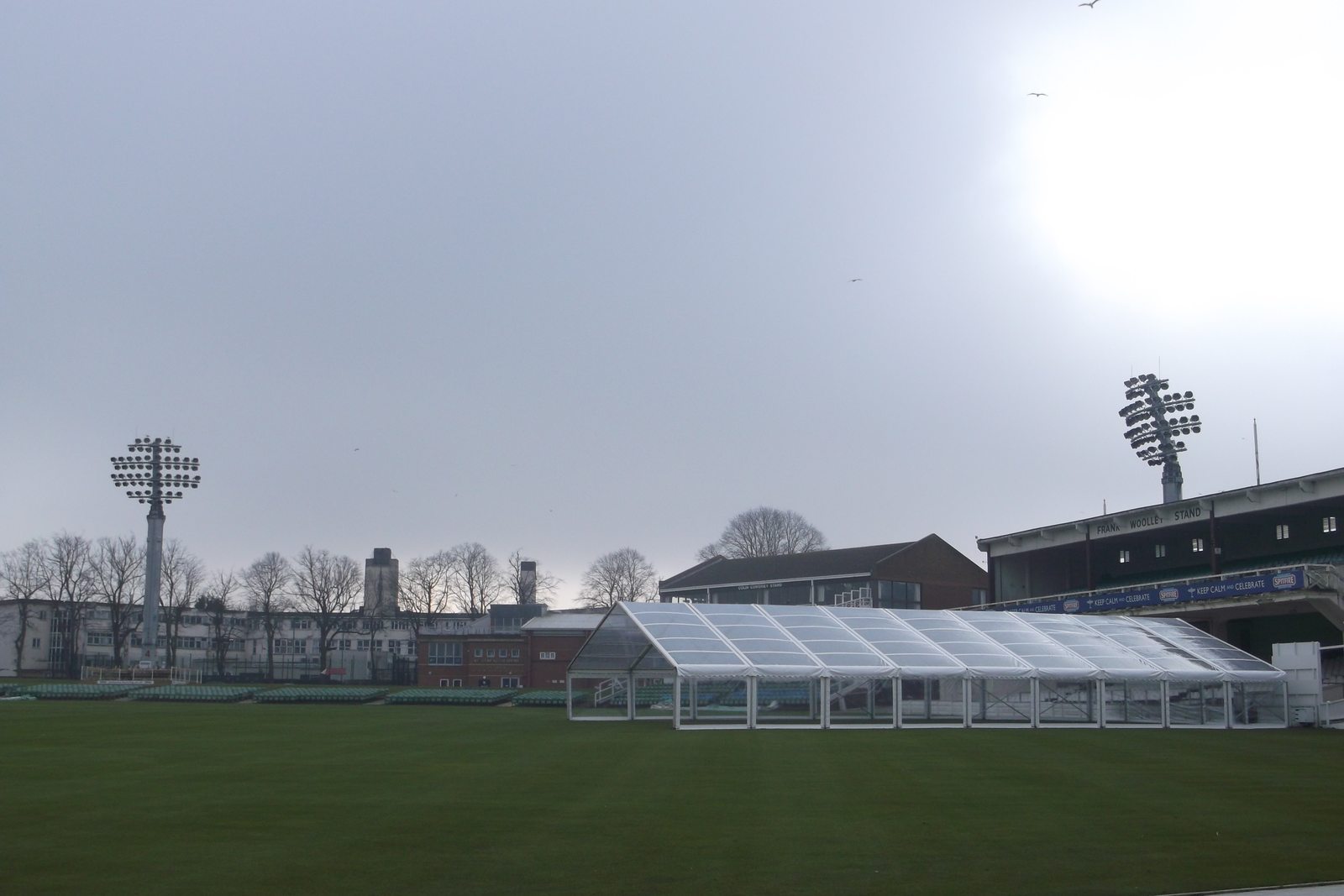
St Lawrence Ground, February 2013

St Lawrence and the beginnings of Cricket Week
Canterbury Cricket Week is older than the ground now associated with it. Kent dates the festival’s origins to 1842, while its history places the opening of St Lawrence in 1847. Those dates explain why the club can celebrate a festival anniversary different from the anniversary of the present venue. They also make Canterbury unusual: the recurring occasion helped establish the ground’s identity, rather than being a later event added to an already settled stadium. [2] [1]
Kent’s account of Cricket Week describes a ground ringed by marquees, with cricket and accompanying events bringing visitors together. The attraction was the combination of a match and a social gathering. Our suggestion is to keep that wider picture in mind when looking at historical photographs: the temporary structures and spectators around the boundary are part of the story, alongside the cricketers in the middle. The annual programme changes, but the idea of concentrating a visit around a festival has deep roots here. [2]
W.G. Grace and a first-class landmark
In Canterbury Cricket Week in 1876, W.G. Grace scored 344 for MCC against the Gentlemen of Kent. Kent’s own anniversary selection identifies this as the first triple century in first-class cricket. The teams are worth noticing: this was a festival fixture involving MCC and the Gentlemen, rather than a modern County Championship match. A single historic ground could bring together several kinds of cricket within the same celebratory week. [3]
Grace’s innings gives the field a significance beyond Kent’s own honours. When watching a contemporary match, it is striking to imagine a performance on that scale being made in the same setting before today’s stands and matchday systems existed. Our suggested way to approach the ground’s history is to connect a few memorable events with visible places, rather than try to remember every statistic. The festival, the tree and the old stand provide particularly strong starting points.
The lime tree inside the boundary
The most famous feature of St Lawrence was a lime tree within the playing area. The Kent Cricket Heritage Trust explains the special rule associated with it: a shot striking the tree counted as four, even if it touched only a leaf on its way out of the ground. Clearing it entirely was a much rarer achievement. This living obstacle gave cricketers a target and spectators a story that an ordinary boundary landmark could scarcely match. [4]
The original tree fell in a winter storm in January 2005. The Heritage Trust identifies clear evidence for towering hits by Arthur Watson, Learie Constantine and Carl Hooper, while treating the often-repeated claim for Jim Smith as less certain. That distinction is part of the fascination of cricket history: a familiar story can be reconsidered when researchers return to contemporary reports. The old lime’s role in matches remains one of Canterbury’s most individual memories. [4]
A concrete stand with a great cricketer’s name
The Kent Cricket Heritage Trust dates the Frank Woolley Stand to 1927, when it replaced the wooden Telegraph Stand used by journalists and scorers. The new structure was built with two tiers and a cantilevered design, and initially carried the straightforward name Concrete Stand. It was renamed for Woolley in 1973. Recognising that sequence makes the building easier to read: its architecture and its commemorative name belong to different stages of the ground’s history. [5]
The Trust records refurbishment in 1972 and further repair work in 2022. The stand therefore represents continued maintenance as well as survival. Woolley’s name recalls Kent’s leading run-scorer and most frequent first-class player, a cricketer whose career crossed the First World War. From elsewhere in the ground, notice the structure as a distinctive older element among newer facilities. Its scale and profile offer a useful comparison with the modern pavilion and hospitality areas. [5]
Kent’s great sides and the names around the field
Kent’s first County Championship came in 1906. The club’s history describes emphatic victories over Sussex and Lancashire during Canterbury Week, including Arthur Fielder taking eleven wickets in the Lancashire match. That game became the subject of Albert Chevallier Tayler’s celebrated painting. It is an example of an event at a county ground acquiring a second life through art, preserving the occasion for viewers who never saw the original team. [6]
The Underwood and Knott Stand commemorates another great partnership. Kent records that the former Annexe Stand was renamed in 2011 for Derek Underwood and Alan Knott, whose bowling and wicketkeeping combined for both county and country. Their shared name describes a cricketing relationship rather than merely two individual honours. Our recommendation is to look for such paired stories around the ground: they explain how a team’s success depended on complementary skills and on players learning each other’s methods. [7]
Rebuilding for evening cricket and year-round use
Kent’s redevelopment updates from the winter of 2010–11 describe the Chiesman Pavilion, players’ areas and annexe being stripped back for work, with changes to entrances and landscaping. By March 2011 the floodlight structures were being installed. These were substantial alterations to how the ground operated and to its skyline. The older pavilion and stand names remained familiar, while the spaces behind them were adapted for the demands of a modern county club. [8] [9]
The club’s financial report for the year ending October 2011 described completion of that phase as a major milestone. Its account is helpful because it distinguishes work delivered from the larger ambitions of a redevelopment scheme. For a spectator, the visible lights are the most obvious symbol of the change, but entrances, dressing rooms and hospitality facilities are equally part of the transformation. Historic grounds continue by being useful, and Canterbury’s redevelopment shows that process in practical terms. [10]
Why the ground is called the Spitfire Ground
The commercial name the Spitfire Ground, St Lawrence dates from 2013, through Kent’s partnership with Shepherd Neame. The club confirms the date in its account of chief executive Jamie Clifford’s service, which also refers to the major redevelopment. St Lawrence remains within the name, preserving the geographical identity familiar from generations of scorecards. Visitors reading older reports headed simply St Lawrence Ground are following the history of this same Canterbury venue. [11]
That naming chapter sits alongside the county’s wider use of the Spitfires identity. For historical orientation, the city, St Lawrence and the individual stand names are more durable clues than any single piece of advertising. Our suggestion is to compare the title on your ticket with the heading on a historical scorecard: it is an easy way to see how commercial presentation changes without a club moving home. The main Canterbury hub uses the current venue identity for practical planning.
What to notice before the next over
Kent’s Heritage Trust offers ground tours, and the club’s match information describes opportunities to learn about buildings, people and the trees associated with St Lawrence. A tour is useful when the history you want to see lies inside an area that your match ticket does not include. Consult the advertised tour arrangements for the day rather than assuming a match interval allows access everywhere. The public view from the boundary still reveals much of the ground’s architectural variety. [12]
Begin by identifying the Frank Woolley Stand, then compare it with the redeveloped pavilion areas and floodlights. Think of Canterbury Week as a whole-ground occasion, with spectators and temporary facilities filling the edges as well as cricket occupying the centre. The hub’s seating and accessibility guides provide the practical route between these places. On a quiet county afternoon, the mixture of old structures, remembered players and changing match formats becomes particularly easy to appreciate.
What to look for on your visit
- Frank Woolley Stand. Identify the Frank Woolley Stand and its surviving cantilevered profile. [5]
- Underwood and Knott. Look for the Underwood and Knott name, which commemorates a partnership between bowler and wicketkeeper. [7]
- Ground tours. Use the Heritage Trust’s tour arrangements to explore more of the ground when available. [12]
For today’s stands, ticket routes, travel and accessibility, use the Canterbury visitor guide and accessibility guide.
Sources and further reading
Sources for Canterbury connect the dates, performances and changes described here to club archives and published historical accounts.
- Confirmed — Kent club history
- Confirmed — Kent: Canterbury Cricket Week
- Confirmed — Kent: anniversary history selection
- Confirmed — Kent Heritage Trust: the lime tree
- Confirmed — Kent Heritage Trust: Woolley Stand
- Confirmed — Kent club history: 1906
- Confirmed — Kent: Derek Underwood tribute
- Confirmed — Kent: March 2011 redevelopment
- Confirmed — Kent: December 2010 works
- Confirmed — Kent: 2011 financial results
- Confirmed — Kent: naming date and redevelopment
- Confirmed — Kent: ground tour information