Taunton: the history of the cricket ground
Researched 17 October 2026 · Club archives and primary sources
Somerset began playing at Taunton in 1882, at a ground beside the River Tone that had been created for several sports. Its history joins local cricket, celebrated overseas players and international tournaments, with the names on today’s pavilions offering a route through the story. [1] [2]
History at a glance
A timeline of Taunton
- 1881Taunton Athletic Society constructs the sports ground. [1]
- 1882Somerset plays here for the first time. [1]
- 1896Somerset purchases the freehold. [1]
- 1983England plays Sri Lanka in the men’s World Cup. [1]
- 2015The Somerset Pavilion opens. [1]
- 2016Cooper Associates becomes the ground naming partner. [7]
- 2019LED floodlights are installed. [1]
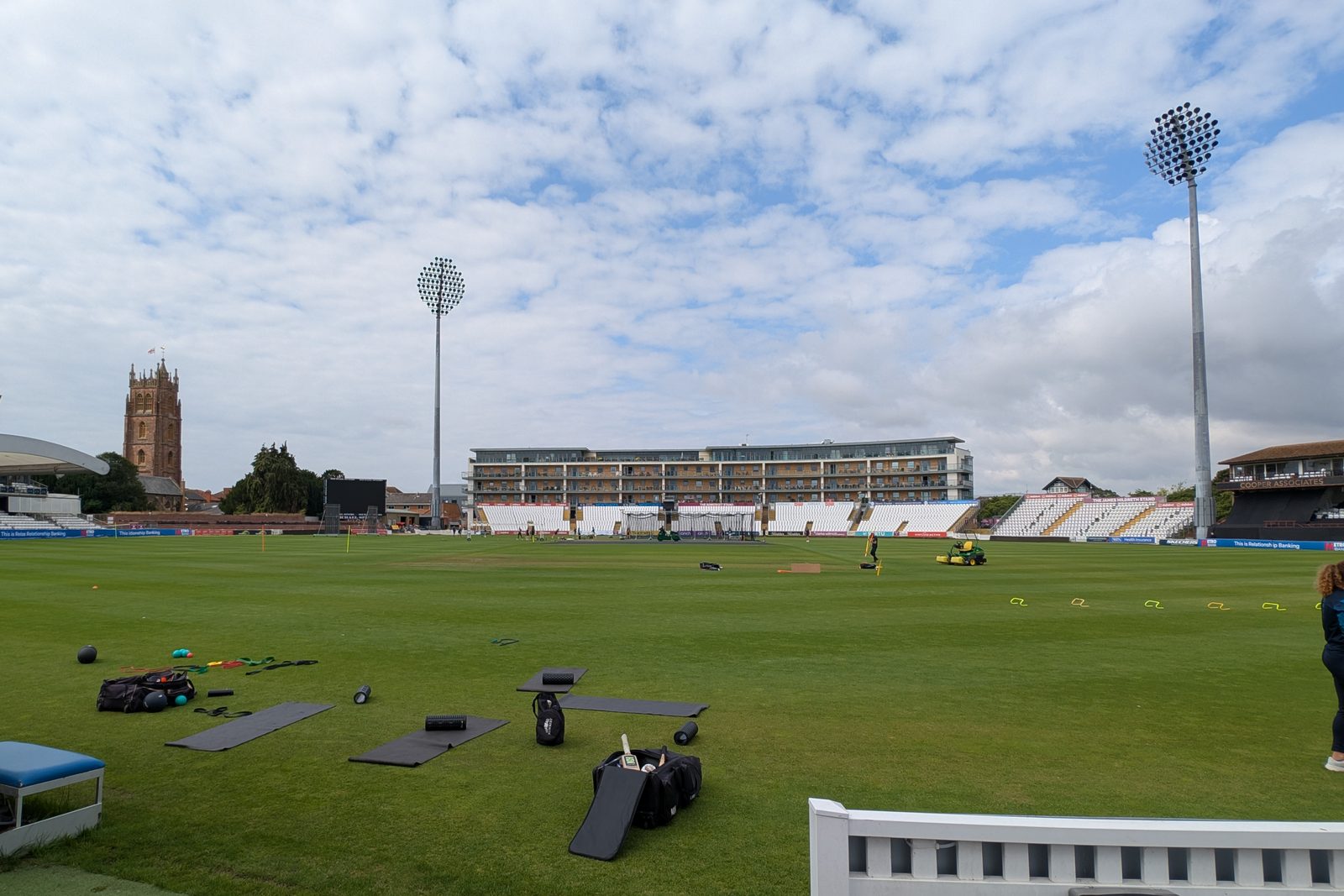

A county home beside the River Tone
The present ground’s beginnings belong to Taunton’s wider sporting life. The venue’s own history dates its construction by Taunton Athletic Society to 1881; Somerset’s first fixture followed in August 1882, with the touring Australians appearing later that month. A visitor looking across a cricket square today is therefore seeing a place first developed for a broader sporting purpose. County cricket gradually became its defining activity, while the riverside location remained. [1]
Somerset itself was older. The county club was formed at Sidmouth on 18 August 1875 after a match between the Gentlemen of Somerset and the Gentlemen of Devon. The club travelled between venues before settling at Taunton. The River Tone is explicitly part of Somerset’s account of that arrival. Remembering the itinerant beginning helps explain the continuing interest in Somerset’s former outgrounds and the county-wide loyalties that come together here on matchdays. [2]
The Athletics Ground and the Stragglers
The Somerset Cricket Museum traces an earlier name, the Athletics Ground, to the original sports venture. Its history of the Somerset Stragglers records Somerset taking the lease in March 1887, after which County Ground became the familiar name. The museum’s account also shows that the field supported a network of local clubs. It was shared by county players, Taunton cricketers and the Stragglers, rather than being an isolated professional arena. [3]
The Stragglers were founded at a meeting in the Ladies Pavilion on 27 August 1900. Their later involvement included assistance towards a scoreboard and a long association with an enclosure on the ground. That background gives the Stragglers name around the modern venue a meaning beyond a convenient café sign. Our suggestion is to notice these smaller names as well as the internationally famous ones: they preserve something of the everyday club relationships that helped the County Ground survive and develop. [3]
Gimblett, Botham, Richards and Garner
Somerset’s own history identifies Harold Gimblett as its leading first-class run-scorer, with 21,142 runs for the county. It also remembers the partnership of Ian Botham, Viv Richards and Joel Garner in the trophy-winning era between 1979 and 1983. These are different strands of Somerset cricket: a locally rooted batting hero and a team whose great names drew attention far beyond the West Country. Their presence in the ground’s vocabulary gives a walk around the boundary a strong connection with the players. [2]
Gimblett’s memory extends beyond Taunton. Somerset’s account of the dedication of new doors at St George’s Church in Bicknoller describes an occasion attended by his family, cricket museum representatives and the local cricket community. It is a reminder that county heroes belong to villages and clubs as well as scorebooks. When you see Gimblett’s name at Taunton, it is worth remembering those connections with the places from which Somerset’s players and supporters came. [4]
Pavilions that explain the modern ground
The Somerset Pavilion opened in late 2015, with a supplier involved in its construction recording the completion of the new building. That opening marked a visible change to this part of the ground. From outside, compare the pavilion’s shape with the smaller-scale parts of the perimeter. Our suggestion is to use it as a starting point for reading the modern venue, then look for the commemorative player names attached to the different buildings. [10]
Improvements have continued inside existing buildings as well. In its update on building work, Somerset described alterations to the Ondaatje Pavilion, including moving the Somerset Cricket Foundation into former shop space and accommodating coaching staff. That is another part of ground development easily missed from a seat: offices, community work and player preparation also compete for room. A county ground must function through the week and outside the season, as well as provide a good view of the pitch. [5]
World Cup batting and Women’s Ashes cricket
Women’s international cricket supplies another memorable Taunton chapter. Somerset’s retrospective on the opening ODI of the 2015 Women’s Ashes recalls England beating Australia by four wickets with 26 balls remaining. It also describes the teams assembling at the ground for a launch event before the match. The occasion brought international attention to a venue familiar to county supporters, and gave spectators the chance to follow an Ashes contest from the same surroundings they knew from Somerset games. [11]
Cricket Australia’s retrospective on Sourav Ganguly singles out his 183 from 158 balls against Sri Lanka at Taunton in the 1999 tournament. It describes what was then the second-highest individual score in men’s World Cup history. Such an innings changes the scale on which a ground is remembered: the familiar Somerset outfield becomes part of another country’s sporting memory. For a visitor, this is a useful reason to look past the home side’s honours and imagine the colours and supporters of visiting international teams in the same seats. [6]
From County Ground to the current sponsored name
Cooper Associates became Somerset’s ground naming partner in 2016. Its subsequent partnership announcement confirms that origin and the name the Cooper Associates County Ground. Older scorecards headed County Ground, Taunton refer to this same place. The naming agreement added a commercial identity to an established venue rather than marking a move to a new field. Keeping Taunton in mind remains the easiest way to connect old match reports with a present-day ticket. [7]
The partnership’s later extension through the end of the 2030 season illustrates how the commercial name has become part of the club’s current presentation. On a historical visit, distinguish it from commemorative names honouring players: one records a business relationship, while another remembers a cricket career. Both can be useful bearings around the venue, but they tell different stories. A building’s current sign also need not be the name used when it opened. [8]
A working ground with a museum at its heart
Somerset’s A–Z visitor guide identifies the cricket museum as an on-site attraction, open to visitors on matchdays without an admission charge, with voluntary donations welcomed. The collection covers Somerset cricket and the wider game. This is the most direct way to add objects and photographs to the names seen around the field. Allow time for it during your visit and consult the museum’s own arrangements if you want to attend outside a matchday. [9]
Our suggested way to explore is to begin with the riverside setting, identify the named pavilions from your seat, then use a break to visit the museum. Compare a historic ground photograph with the present skyline: the distinction between an old name and a new building soon becomes clearer. For choosing an actual match seat, use the hub’s stand guides and accessibility information; the historical route works best as an addition to a day already planned around the cricket.
The museum’s own account of its art collection describes paintings of Somerset players, including Gimblett, alongside works displayed in the club’s pavilions. Looking at a painted portrait after seeing the player’s name on a stand can make that commemoration feel more personal. It also gives anyone accompanying a cricket enthusiast another way into the ground’s past, through pictures and objects rather than bowling averages. [12]
What to look for on your visit
- Pavilions. Find the Marcus Trescothick and Colin Atkinson pavilions and compare their shapes across the field. [1]
- Stragglers. Notice the Stragglers name and its connection with the amateur club. [3]
- Somerset Cricket Museum. Visit the on-site cricket museum during its advertised opening arrangements. [9]
For today’s stands, ticket routes, travel and accessibility, use the Taunton visitor guide and accessibility guide.
Sources and further reading
Sources for Taunton connect the dates, performances and changes described here to club archives and published historical accounts.
- Confirmed — venue history
- Confirmed — Somerset club history
- Confirmed — Somerset Cricket Museum: Stragglers history
- Confirmed — Somerset: Harold Gimblett doors
- Confirmed — Somerset: building work
- Confirmed — Cricket Australia: Ganguly at Taunton
- Confirmed — naming partner: 2016 origins
- Confirmed — naming partner: extension
- Confirmed — Somerset visitor A–Z
- Confirmed — project supplier: Somerset Pavilion opening
- Confirmed — Somerset: England win Taunton Ashes ODI
- Confirmed — Somerset Cricket Museum: sport and art
Explore the other grounds
- Lord’s history
- The Oval history
- Edgbaston history
- Old Trafford history
- Headingley history
- Trent Bridge history
- Hove history
- Canterbury history
- Chelmsford history
- New Road history
- Derby history
- Grace Road history
- Wantage Road history
- Southampton history
- Sophia Gardens history
- Chester-le-Street history
- Bristol history