Chelmsford: the history of the cricket ground
Researched 17 October 2026 · Club archives and primary sources
Essex first played at Chelmsford in 1925 and bought the ground in 1966. Its history joins the county’s life on the road with the Championship sides that made this compact setting famous. [1] [2]
History at a glance
A timeline of Chelmsford
- 1925Essex plays Oxford University at Chelmsford. [1]
- 1966The club purchases the ground. [2]
- 1979Essex wins its first Championship and first major one-day trophy. [4]
- 1991–1992Successive Championship titles complete a great county era. [2]
- 2017Essex wins the Championship without losing a match. [5]
- 2019Essex achieves the Championship and T20 double. [6]
- 2024The bowling ends are named for Cook and Gooch. [12]
- 2025Ambassador Cruise Line becomes the naming partner. [9]
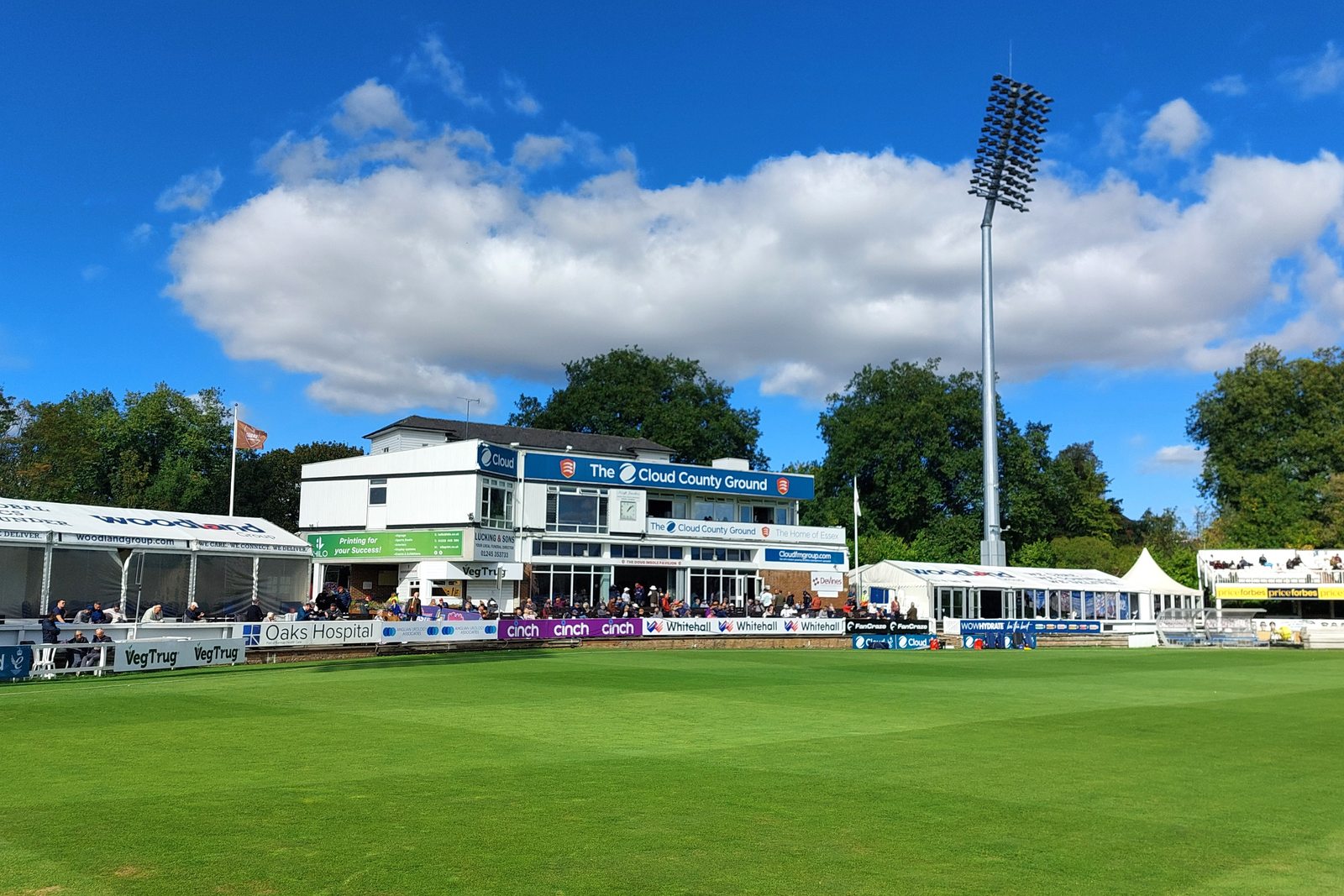
Chelmsford, September 2024

A Chelmsford beginning before a permanent home
The first Essex match at the ground was against Oxford University, beginning on 20 June 1925. The scorecard survives in ESPNcricinfo’s archive, and Essex marked the centenary of cricket at Chelmsford in 2025. Those dates describe the start of play at this venue, rather than the founding of the club. A visitor reading an anniversary banner or an old scorecard will encounter both histories, which developed along different timelines. [1] [3]
The club’s centenary article illustrated the ground’s past with a touring West Indies match and a later Championship celebration. That combination is a useful introduction to Chelmsford: touring sides, the regular county season and limited-overs evenings all contribute to its memories. The same article connected the anniversary with the arrival of a professional Essex Women’s team, placing a new chapter beside the older photographs. The ground remains a place where the county’s history is being made in different forms of cricket. [3]
From the Essex circuit to ownership
Essex’s history traces a home at Brentwood, a move to Leyton and then a long period of taking matches around the county. Festivals at places including Colchester, Ilford and Southend became part of the club’s identity. Chelmsford was one stop in that wider pattern before ownership of the New Writtle Street ground gave it a firmer place in the county’s plans. The old circuit helps explain why Essex support extends far beyond the city. [2]
The purchase came in 1966, assisted by an interest-free loan arranged through Trevor Bailey from the Warwickshire Supporters’ Association. Essex’s own history makes clear the importance of that financial help. Owning a home required the work of administrators and supporters as well as a successful team. When looking at the tightly enclosed field today, remember that its permanence was achieved through decisions about land and money, not simply through the accumulation of memorable performances. [2]
The long wait ends in 1979
Essex’s first major trophy was the Benson & Hedges Cup in 1979, followed by the County Championship in the same season. The club’s retrospective on the cup final describes how long supporters had waited for silverware. Graham Gooch’s contribution and Keith Fletcher’s captaincy became central to the memory of that breakthrough. The cup final took place at Lord’s, but its significance was felt at the county’s home and throughout Essex. [4]
The distinction between the place where a trophy is won and the home of the winning team is worth keeping in mind at Chelmsford. County cricket builds a season from many grounds, while its celebrations and shared memories gather around the home venue. Our suggestion is to read the ground’s named areas as an introduction to the people who made that breakthrough possible. Fletcher, Gooch and their contemporaries represent the transition from an ambitious county to a sustained force in domestic cricket.
An unbeaten Championship season
The ECB’s review of the 2017 season records Essex’s return to Championship-winning form without losing a match. It was a remarkable achievement for a side newly back in the top division. The season renewed the connection between Chelmsford and successful red-ball cricket for a generation that had grown up after the earlier great teams. Looking at the modest ground around you, it is easy to understand why that success became such a strong source of local pride. [5]
The ECB’s account places Essex within the wider competition, where promotion and relegation shape each club’s ambitions. Winning the title immediately after promotion gave the campaign a particular narrative: supporters were watching a team exceed the expectations attached to its starting position. For someone visiting now, this is a useful reminder that the meaning of a county season depends on what came before it. A title can represent both a return to an old standard and a fresh beginning. [5]
The extraordinary double of 2019
Essex’s winter members’ magazine celebrated the club becoming the first side to win the County Championship and the T20 title in the same year in 2019. Those competitions ask very different things of a team, making the combined achievement a distinctive part of the county’s history. A visitor who knows Chelmsford mainly for lively T20 evenings may find the ground’s red-ball identity equally strong; supporters saw both ambitions rewarded in one season. [6]
The club’s later account of Anthony McGrath’s finest Essex moments revisits that double and the following Bob Willis Trophy success. It links the achievements through the coaching group and a team able to adapt between formats. Chelmsford’s historical story is therefore broader than a single famous match. Our view is that its strongest theme is continuity: a compact county home capable of nurturing successive teams, with familiar spectators watching the slower contests and the short, intense evening games. [7]
County Ground, Cloud and Ambassador
Older reports use several commercial names for Chelmsford. Essex’s January 2025 farewell to Cloud explains that its naming partnership had covered a notably successful period, including the 2019 double. The club then announced Ambassador Cruise Line as its new ground naming partner in February 2025. The current name, the Ambassador Cruise Line Ground, therefore belongs to the latest commercial chapter at the same New Writtle Street venue. [8] [9]
County Ground and Chelmsford are the most useful anchors when comparing material from different seasons. Our recommendation is to keep the city in any search for an old match, especially when the sponsored name in a programme no longer matches the wording on today’s tickets. Naming changes can make a continuous history appear fragmented, but the underlying place is familiar. The county’s centenary celebration and the new naming agreement happened in the same year, neatly joining continuity with change. [9]
Development plans and the ground that survives
Chelmsford’s redevelopment history includes ambitious proposals as well as alterations achieved on site. In its account of the scheme, development partner MCD describes plans for residential towers overlooking the River Can, Central Park and the cricket ground, alongside renewed cricket facilities. That description explains the link between the club’s riverside setting and the commercial value of neighbouring land. It also shows why a history of the ground must distinguish a development proposal from a completed stadium. [10]
Essex’s published AGM material has discussed the viability of redevelopment and recorded that there was no settled timetable at that point. Our advice when comparing drawings or newspaper illustrations with the present ground is to read the accompanying date and status carefully. A planned tower, stand or entrance can remain part of a proposal through several seasons. For the arrangement used on your matchday, the current seating plan and visitor information are more useful than a historical artist’s impression. [11]
Cook, Gooch and a visit today
The club’s annual report records the renaming of the bowling ends in 2024. The River End became the Sir Alastair Cook End, while the Hayes Close End became the Graham Gooch End. These names turn the axis of the pitch into a tribute to two Essex and England batting careers. They are particularly useful bearings because older scorecards and commentary may still refer to the geographical names that preceded them. [12]
From your seat, identify both ends before following the surrounding stand names. Then compare the enclosed cricket setting with the river and park outside: Chelmsford’s appeal lies partly in that close relationship between a city-centre ground and its surroundings. The main hub provides seating, travel and accessibility links for the practical visit. Our suggested historical focus is simple: the first county match, the purchase that secured the home, and the teams whose titles made this small field widely recognised. [10]
What to look for on your visit
- Bowling ends. Identify the Sir Alastair Cook and Graham Gooch bowling ends, formerly River and Hayes Close. [12]
- Centenary photographs. Compare the present ground with photographs used in Essex’s centenary celebration. [3]
- River Can. Look towards the River Can and park setting when approaching or leaving the cricket ground. [10]
For today’s stands, ticket routes, travel and accessibility, use the Chelmsford visitor guide and accessibility guide.
Sources and further reading
Sources for Chelmsford connect the dates, performances and changes described here to club archives and published historical accounts.
- Reported — ESPNcricinfo archive: Essex v Oxford University, June 1925
- Confirmed — Essex detailed club history
- Confirmed — Essex: Chelmsford cricket centenary
- Confirmed — Essex: first trophy retrospective
- Confirmed — ECB: the Championship in 2017
- Confirmed — Essex: winter 2019 members’ magazine
- Confirmed — Essex: McGrath’s finest moments
- Confirmed — Essex: Cloud naming partnership ends
- Confirmed — Essex: Ambassador naming agreement
- Confirmed — MCD: Chelmsford scheme proposal
- Confirmed — Essex: published AGM minutes
- Confirmed — Essex: 2024 annual report