Southampton: the history of the cricket ground
Researched 17 October 2026 · Club archives and primary sources
Hampshire moved to the Rose Bowl in 2001, creating a new home outside Southampton that grew into an international venue. Today the Utilita Bowl combines county cricket with a hotel, major finals and a place in the story of the Twenty20 game. [2] [6] [3]
History at a glance
A timeline of Southampton
- 2000Second XI cricket begins during construction. [1]
- 2001Hampshire begin first-team cricket at the Rose Bowl. [2]
- 2003The opening round of Twenty20 includes Hampshire against Sussex here. [3]
- 2010Hampshire win the T20 final on their own ground. [4]
- 2015The completed Hilton becomes a new backdrop. [6]
- 2021New Zealand win the inaugural World Test Championship final. [7]
- 2024The venue becomes the Utilita Bowl. [8]

A new home beyond Northlands Road
The modern ground began with a long building project, rather than an overnight move. Hampshire’s heritage account traces planning and negotiations through the years before the club left Northlands Road. An early target for first-class cricket was 1995, but legal discussions, the economy and construction all affected the timetable. The wide site at West End offered a different future from the county’s old city home, with space for a larger cricket operation and the ambition to attract international matches. [1]
Work on the main pavilion, atrium and academy began in January 2000. Trevor Brooking opened the clubhouse and nursery ground that May; second-team games followed while the main venue was still taking shape. Hampshire’s last matches at Northlands Road were played later that year. These overlapping stages explain why photographs of the earliest cricket show an unfinished setting: the playing surface and supporting buildings did not all reach completion together. [1]
Rain, then a winning Championship start
The planned first senior match, against Essex on 2 May 2001, was washed out without a ball bowled. Surrey supplied the first opposition to play two days later and defeated Hampshire. Those unpromising opening days soon gave way to a more encouraging result when Worcestershire arrived for the new ground’s first County Championship match on 9 May. Hampshire won inside three days by 124 runs, giving supporters an early home victory to associate with their unfamiliar surroundings. [2]
Dimitri Mascarenhas supplied a particularly neat set of firsts. He made the ground’s first century after Hampshire had slipped to 79 for six, and took its first wicket. Alex Morris finished with eight wickets for 66 runs in the match; Graeme Hick contributed a century for Worcestershire. Those performances connect the opening to identifiable players and a competitive county contest. The venue’s later international reputation grew out of a home season that had already produced a memorable recovery. [2]
A place in Twenty20’s opening night
The Rose Bowl was part of Twenty20’s beginning on 13 June 2003. Hampshire met Sussex in the first round of the new competition, in the match shown live by Sky. Hampshire won by five runs before a full house. The county’s own account records 8,687 spectators: a sharply different occasion from the quieter rhythm of a Championship day. For visitors following the history of short-format cricket, this is a ground with a connection to the format’s launch as well as its later trophies. [3]
The significance lies in the combination of a new venue and a new way of presenting the game. Evening cricket, a compact contest and a television audience could bring a different crowd through the gates. Looking around a modern Blast match, it is possible to recognise how central that kind of occasion has become to the ground’s identity. The first Sussex fixture also gave a familiar regional rivalry a new setting and a new competition. [3]
The final that Hampshire won at home
In 2010 the Rose Bowl staged Finals Day, and Hampshire made full use of the home setting. After beating Essex in the semi-final, they faced Somerset in a match that ended in confusion and celebration. Somerset made 173 for six; Hampshire’s chase reached the last delivery with the title still undecided. Daniel Christian was injured and using Jimmy Adams as his runner, with Sean Ervine at the other end. [4]
Christian, Adams and Ervine all moved as the final ball was played. Somerset failed to take advantage of the confusion, and Hampshire secured the trophy with the scores level under the competition’s tie-breaking rules. The scene is remembered for the unusual finish, but it also marked the county’s first T20 title. For Hampshire followers, this is one of the strongest reasons to distinguish the Rose Bowl’s own match history from the wider honours won by the club at other venues. [4]
From one-day internationals to Test cricket
South Africa and Zimbabwe played the first international here in 2003. The following year the Rose Bowl was among the venues for the Champions Trophy, bringing several national sides to Hampshire. That progression made the new ground an established part of England’s international circuit before Test cricket arrived. It also means a visitor can encounter several names in old reports while tracing the same playing field and its successive additions. [5]
The first Test was England against Sri Lanka in 2011. India later provided two notable England victories, in 2014 and 2018; Hampshire’s retrospective records the latter as a 60-run win. International cricket brought longer matches, different demands on the surrounding facilities and a wider audience for the venue. The pavilion and spectator bowl thus became familiar beyond the county season, while the ground continued to serve as Hampshire’s regular home. [5] [9]
The hotel changes the view
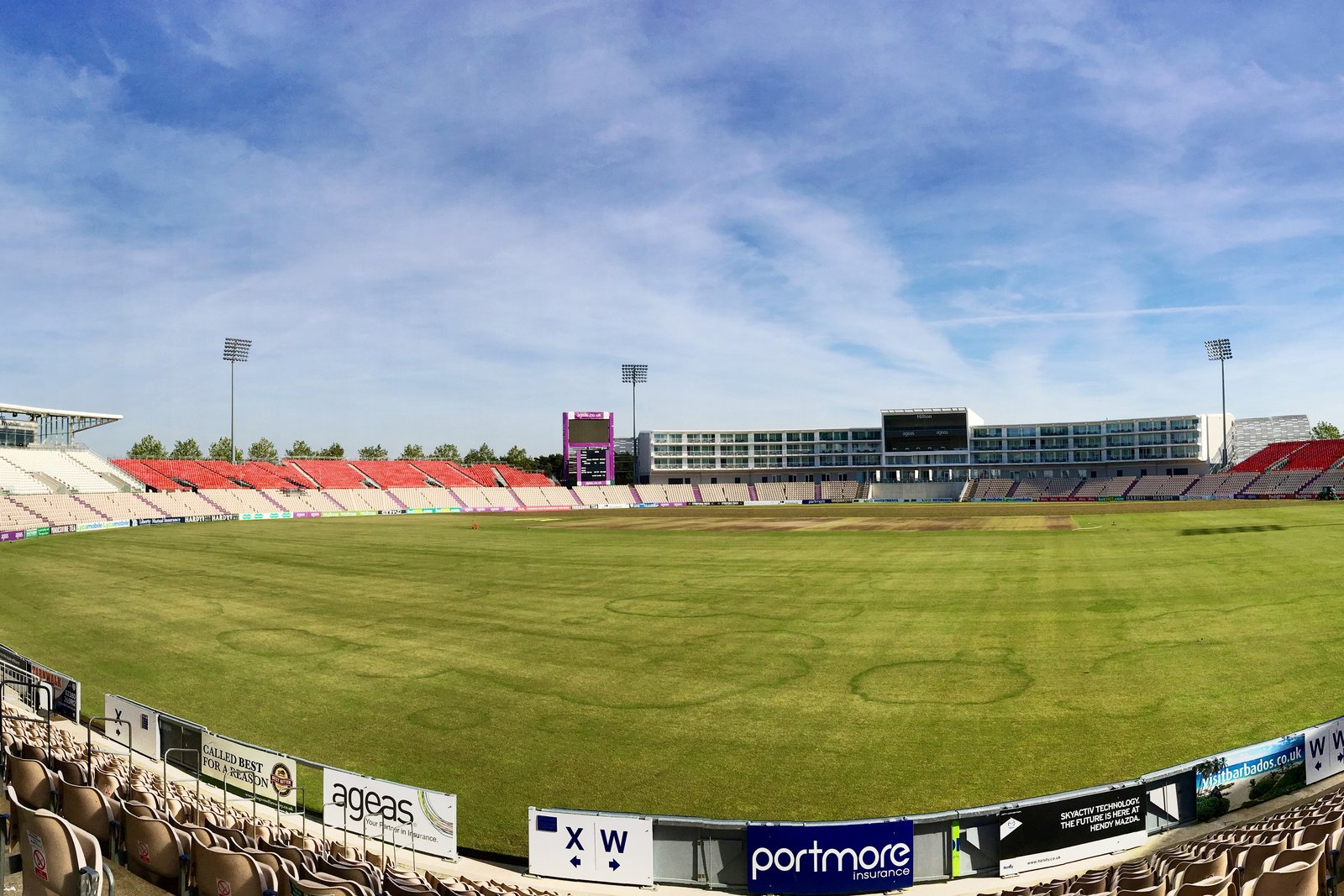
The completed Hilton hotel was announced in May 2015. Its position overlooking the playing field created one of the venue’s defining modern views, with Hampshire’s T20 match against Essex on 15 May identified as the first game in front of the finished building. The hotel also brought meeting rooms, dining and leisure facilities into the cricket complex. It was a major change to what spectators saw at that end of the ground. [6]
The development helps explain the contrast between early Rose Bowl images and the ground visitors recognise now. The setting became a place where people could stay and attend events as well as arrive for a match. For a history-minded spectator, compare the hotel’s scale with the original pavilion and the open curve of the seating. Each belongs to a different stage in the work of making the site commercially viable throughout the year. [6]
A world final in Hampshire
New Zealand and India contested the inaugural World Test Championship final here in June 2021. Rain forced use of the reserve day, but the match still produced a decisive result. New Zealand dismissed India for 170 in their second innings and were left 139 to win. Kane Williamson and Ross Taylor completed the pursuit, securing an eight-wicket victory and making New Zealand the first winners of the competition. [7]
The ICC used the name Hampshire Bowl for the event. That wording belongs to the same Southampton venue that supporters knew as the Rose Bowl and the Ageas Bowl. The final gave the ground a place in Test cricket’s global championship history quite apart from England’s home series. It is a useful match to recall when looking from the pavilion towards the hotel: a relatively young county ground had become the stage for a meeting between the world’s leading Test sides. [7]
The Rose Bowl, the Ageas Bowl and the Utilita Bowl
The original Rose Bowl name remains embedded in the ground’s early story and in supporters’ memories. Later records use the Ageas Bowl, while the current naming partnership introduced the Utilita Bowl on 19 January 2024. The announcement linked the new agreement with energy and environmental work at the venue. It also looked ahead to the ground’s first men’s Ashes Test, allocated for 2027, extending the international ambition that had driven the original move. [8]
Today the pavilion, hotel and surrounding stands are the clearest features to place before a match. Their different forms show that the ground developed in stages, even though its entire senior-cricket history fits within a much shorter span than many county headquarters. Read the older Rose Bowl references alongside the modern signage and the continuity becomes clear: one field has hosted Hampshire’s county recovery, the start of televised domestic T20 and a world Test final. [2] [3] [7]
What to look for on your visit
- Original pavilion. The focal point of the first construction phase. [1]
- Hotel end. The hotel transformed the backdrop in 2015. [6]
- The playing field. Recall Hampshire’s home final and the World Test Championship. [4] [7]
For today’s stands, ticket routes, travel and accessibility, use the Southampton visitor guide and accessibility guide.
Sources and further reading
Sources for Southampton connect the dates, performances and changes described here to club archives and published historical accounts.
- Hampshire Cricket Heritage: developing the Rose Bowl
- Hampshire: the first season in 2001
- Hampshire: the 2003 season and first Twenty20
- Hampshire: the 2010 home final
- Hampshire: international matches at the ground
- Hampshire: hotel opening announcement
- ICC: New Zealand win the inaugural World Test final
- Hampshire: Utilita naming partnership
- Hampshire: the first Test, 16–20 June 2011